Croatian Drinks at a Glance
- Water: tap water is safe to drink; on some smaller islands it can taste different.
- Coffee: idemo na kavu – let’s go for a coffee – is an invitation to sit down and talk.
- Rakija: fruit brandy, and often the first drink offered to a guest.
- Liqueurs: pelinkovac, maraschino from Zadar and teranino from Istria.
- Wine with water: gemišt in continental Croatia, bevanda on the coast.
- Beer: Ožujsko and Karlovačko, plus craft breweries, most of them in and around Zagreb.
- Soft drinks: Pipi, Pašareta and Cedevita.
Water: From the Tap, Jana or Jamnica
In my last post, I have tried to briefly give you a short guided tour of the wines of Croatia. Once you land in the new country the first thing that comes to mind is water…is it safe to drink, can you use it freely, and where can you buy it. Well, the good news is that you can freely drink tap water while in Croatia, especially if you are not sensitive to water changes.
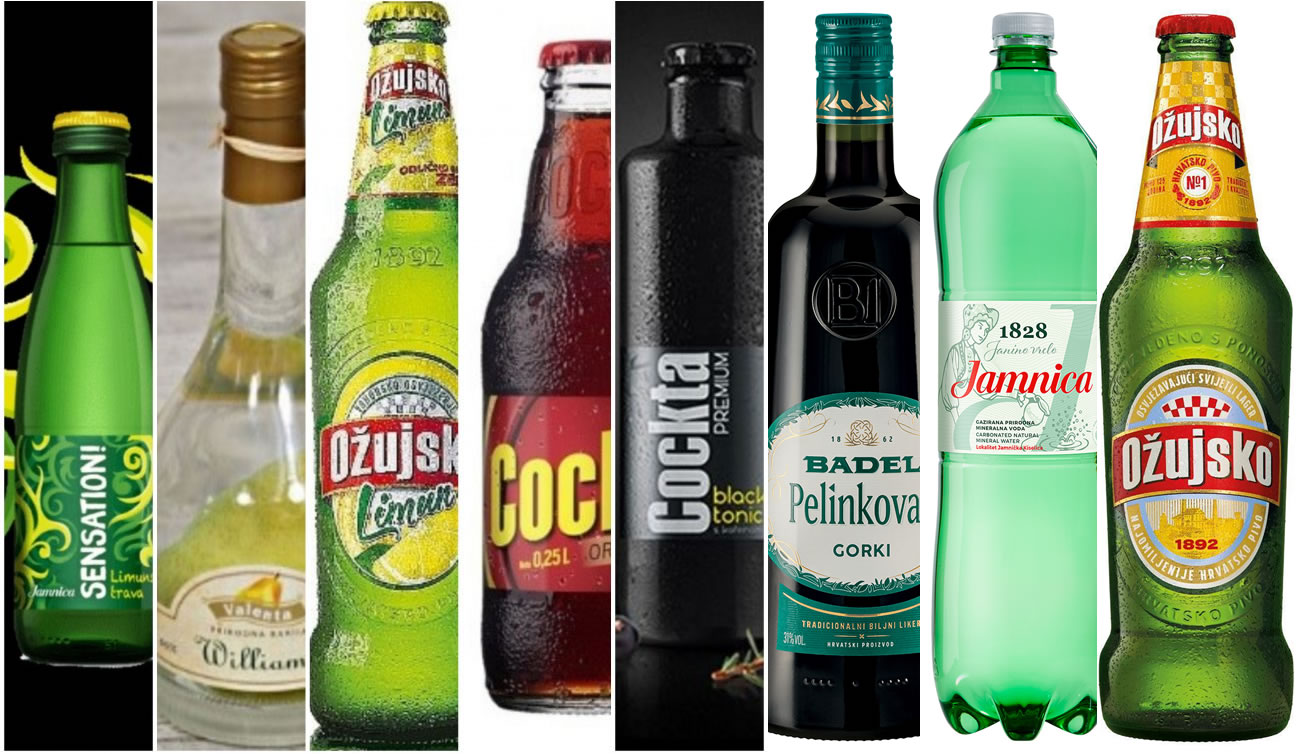
Plenty of water is available at almost every newspaper stand – you just need to ask for a bottle of Jana. If you prefer the fizzy one, order Jamnica, and if you are dwelling what to drink on a hot summer day – order a “Sensation” – Jamnica’s fizzy mineral water flavoured with lime and kiwano, which will refresh you better than any soda drinks.
Some of the smaller islands have no water source of their own and no pipeline from the mainland, so they are supplied by water tanker ships, and the water there can taste different. If you are staying on one, it is worth asking your host.
Coffee: A Reason to Sit Down
Coffee in Croatia is as much about company as caffeine. Idemo na kavu – let’s go for a coffee – is really an invitation to sit down and talk, and nobody will mind if you linger over one cup for a long time. If you would like it with milk, ask for kava s mlijekom.
Rakija: The Welcome Drink
The whole new world will open up to you once you get to discover the plethora of drinks available. Let’s start with “rakija”. The world of rakija is rich: in Croatia it is distilled from plums, pears, apples, grapes and other fruit, and some kinds are flavoured with herbs. It is often the first drink you will be offered as a guest in a Croatian home.
Rakija is usually translated as “fruit brandy” rather than “grappa” or “schnapps”. In folk tradition it is a “remedy” for almost everything, from a headache to knee pain. A bottle of rakija is a “must-have” in many Croatian households.
Viljamovka
One of the best known is Viljamovka – brandy made from Williams pears! It is slightly fruity, and bottled versions usually have 37.5 to 40 % alcohol. For a family with a countryside cottage and an orchard, the pride of the season might be some 100 bottles of homemade rakija!
Loza
If you happen to be holidaying in Croatia, and you get a toothache (of course this is not likely), the old folk remedy is a grape rakija called Loza: a sip is held on the aching tooth for a few seconds.
Šljivovica
Plum rakija. Slavonska šljivovica, from Slavonia in the east of the country, is protected in the EU as a geographical indication.
Travarica
Herbal rakija: herbs such as sage, rosemary or fennel are left to steep in a grape rakija such as loza. It is often drunk at the start of a meal.
Biska
Istria’s mistletoe rakija, made by steeping mistletoe and herbs in grape brandy. It is traditionally linked with Hum, a small hilltop town in inland Istria.
Liqueurs: Bitter, Cherry and Teran
Pelinkovac
People will see you as a real connoisseur if you order “Pelinkovac” on the rocks – mind you, this is not rakija but a bitter herbal liqueur with a wormwood base. Try this one when you can’t decide what to drink – it is served chilled, often with a slice of lemon or orange, and works as an aperitif or a digestif. There is also an orange version, Pelinkovac Orange, made by Badel 1862 in Zagreb.
Maraschino
A clear cherry liqueur from Zadar, distilled from marasca, a sour cherry most closely associated with Dalmatia. Zadar has produced it on an industrial scale since the 18th century, and the Maraska company still makes it in the city today. The maraschino cherries used in cocktails take their name from it.
Teranino
A sweet, dark red liqueur from Istria, made from Teran red wine, fruit brandy and spices. It is served as an aperitif or a digestif.
Wine, the Croatian Way
Among Croatia’s best-known grape varieties are Graševina in continental Croatia, Malvazija in Istria, Pošip on the island of Korčula and Plavac Mali in Dalmatia. We cover them in more detail in our guide to Croatian wines; here is how Croatians mix and drink it.
Gemišt
White wine mixed with sparkling mineral water, in different ratios. The name comes from the German gemischt, mixed, and it is a traditional thirst-quencher in Zagreb and continental Croatia.
Bevanda
The coastal counterpart: usually red wine mixed with still water. In Dalmatia it is a common drink with lunch or dinner, especially in warm weather.
Prošek
A sweet dessert wine from Dalmatia, made from grapes dried in the sun before pressing. Despite the similar name, it has nothing to do with Prosecco, the Italian sparkling wine, although Italian producers have objected to the name in the EU for exactly that reason.
If wine is the reason you are coming, it is worth giving it a few days. On the Pelješac peninsula, Plavac Mali grows on the steep Dingač slopes that run down to the sea, and our seven-day Istria Wine Trails journey travels through Rovinj, Grožnjan and Motovun at a slower pace.
Beer
Finally, in the country with such an amazing craft beer scene, it is worth knowing about the bottled shandy – “Ožujsko Limun”, a lemon radler with 2 % alcohol. It will delight even those not fancying the beer at all. The top lager brand Ožujsko also makes a grapefruit version, Ožujsko Grejp – perfect to savor when you are thirsty.
Ožujsko is brewed in Zagreb by Zagrebačka pivovara, the largest brewery in Croatia; its main rival, Karlovačko, comes from Karlovac. Most of the country’s craft breweries are in and around Zagreb.
Soft Drinks
Last but not least – once upon a time in the former country, a “communist Coca-Cola” was born under the name “Cockta” back in 1953. It soon became the most popular soft drink in the former Yugoslavia. A newer version, Cockta Black Tonic, adds bitter tonic and caffeine to the original recipe.
Cockta was created in Slovenia, and since 2010 it has belonged to Atlantic Grupa, based in Zagreb. Croatia also has three soft drinks of its own.
Cedevita
An instant vitamin drink created in 1969 at the Pliva pharmaceutical company in Zagreb and first sold in pharmacies. The original flavour was orange. Since 2001 it has belonged to Atlantic Grupa.
Pipi
An orange soda from Split, launched in 1971 and named after Pippi Longstocking. In the 1980s and 1990s it had near cult status.
Pašareta
A bright red, carbonated citrus soda made by the Ferenčić family in Pazin since 1924. It is sold mainly in Istria.
Questions Travellers Ask
What is the national drink of Croatia?
Rakija is widely considered Croatia’s national drink. It is a fruit brandy, most often made from grapes, plums or pears, and a small glass is a traditional way of welcoming guests.
What is the difference between gemišt and bevanda?
Both are wine mixed with water. Gemišt is white wine with sparkling mineral water, typical of Zagreb and continental Croatia; bevanda is usually red wine with still water, typical of the Dalmatian coast.
How strong is rakija?
Commercial rakija is usually bottled at around 40 per cent alcohol, and EU rules set a minimum of 37.5 per cent for fruit spirits. Homemade rakija can be stronger.
Which soft drinks are typically Croatian?
Pipi, an orange soda from Split; Pašareta, a red citrus soda from Pazin in Istria; and Cedevita, the instant vitamin drink from Zagreb.
Which Croatian drinks make a good gift?
Maraschino from Zadar and pelinkovac are made by long-established Croatian producers such as Maraska and Badel. From Istria, biska and teranino are distinctly regional choices.
May your days in Croatia be filled with joy – and lots of fun while discovering all these surprising drinks! Bon Voyage!